Introduction
The technique of watercolor painting is based on the transparent or glaze system of pigmentation; that is, it utilizes the brilliant white of the paper for its whites and pale tints, and those pigments which are not normally transparent are applied in such thinned-out consistency that their effects are nearly as brilliant as those which are naturally transparent. The opaque method of pigmentation achieves its whites and pale tints by using a white pigment. Whether one is preferable over the other is a matter for the artists to decide; it depends upon what effects and working properties they want, for each has its own peculiar kind of brilliance and luminosity and each its own good qualities.
The term “aquarelle” specifically designates this type of painting as distinguished from all opaque water mediums, such as gouache, casein, etc.
As a general rule transparent watercolors may be freely introduced ir an opaque technique done on paper, such as gouache or pastel, so long the general character of the work remains gouache or pastel. The introduction of opaque effects into a painting which is predominantly watercolor or aquarelle, however, must be subtly and sparingly done. Although touches of sine white and other opaque pigments can thus be used to advantage, the purist in watercolor realizes that there is a definite limit to the extent to which the may be used if the usually desired watercolor effect of the picture as a whole is to be retained.
THE COLORS
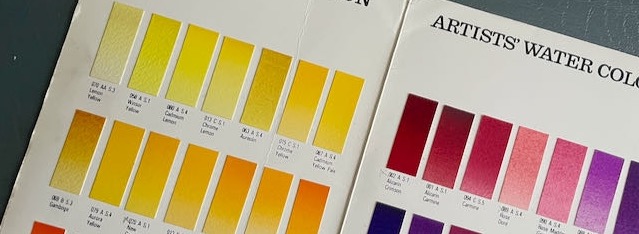
All the permanent pigments approved for use in oil paints may be used, with the exception of the two that contain lead: flake white and true Naples yellow. The naturally transparent pigments such as cobalt yellow, alizarin, and manganese blue yield brilliant effects; the opaque pigments such as the cadmiums can also be made to produce transparent effects when correctly used, because of the thin, sparsely pigmented coats in which they are applied.
Watercolor paints are composed essentially of transparent pigments ground to an extremely fine texture in an aqueous solution of gum. The binding material and pigment must be combined in the proper proportion to permit all of the various manipulations to be accomplished with ease; once this has been done, watercolor paints may be enormously diluted with water and still adhere perfectly to the paper. The ability of the paper to absorb and hold pigment particles in its interstices is at least of equal importance with the adhesiveness of the gum in binding the color to the ground. Anyone who has tried to wash or scrub away the color knows how tenaciously paper clings to the last remnants of color; unlike most of our other painting methods, true watercolor is more like a stain than a continuous film or layer. When watercolor paints are piled up or applied thickly, as in the gouache or casein techniques, the holding or binding action of the paper on pigment particles is naturally less, and the color will have more of the regular paint-film characteristics, will depend a little more on the medium for its binding properties, and may have a tendency to crack especially if the support is not rigid.
When permanent colors are used on pure rag watercolor paper and the picture is kept under the same normal conditions of preservation as are accorded other objects of art, the technique is as permanent as any other. It is not true that the colors are liable to be faded by daylight because they are exposed in such thin films; only the semipermanent or borderline pigments are likely to fade; they will be affected in the same way when used in oil tempera, though such change may be somewhat less noticeable in those techniques on account of the larger volume of color employed.
WATERCOLOR AND GOUACHE
Because of the comparatively low cost and simplicity of a student's watercolor outfit, the medium is universally used as an introductory technique for children and beginners. The production of a successful watercolor painting, however, calls for a considerable degree of technical skill and a well-developed que Because of the portability of the necessary materials, watercolor 1l adapted for sketching purposes. For these reasons, it has become customary to distinguish between a watercolor painting, carefully done in the studio or direct from nature, and a watercolor sketch, made as a note for subsequent work in watercolor or some other medium.
Although examples of work comparable to modern watercolor painting can be cited among the pictures of nearly every period, the technique as we understand it today was not appreciated as a standard art method until the eighteenth century, when the English school established it as such.
Gallery: More Examples
Frequently Asked Questions
What is watercolor painting?
Watercolor painting is a technique that uses water-soluble pigments applied to paper, creating transparent layers, soft transitions, and luminous color effects.
What paper is best for watercolor painting?
100% cotton watercolor paper is best because it absorbs water evenly, prevents warping, and allows for smoother washes and lifting techniques.
What brushes should beginners use for watercolor?
Round brushes with a fine point are ideal for beginners, as they allow both broad washes and detailed lines using the same brush.
Why do watercolor colors look lighter when dry?
Watercolor pigments dry lighter because the water evaporates, leaving a thinner layer of pigment on the paper than when wet.
Can watercolor paintings be corrected or layered?
Yes, but carefully. Light layers can be lifted or painted over, while darker areas are harder to correct due to the transparency of watercolor.
How do you prevent muddy colors in watercolor?
Use clean water, limit over-mixing, allow layers to dry fully, and avoid combining too many pigments in one area.
Is watercolor suitable for professional artwork?
Absolutely. Watercolor is widely used by professional artists for fine art, illustration, and exhibition work due to its expressive and timeless quality.