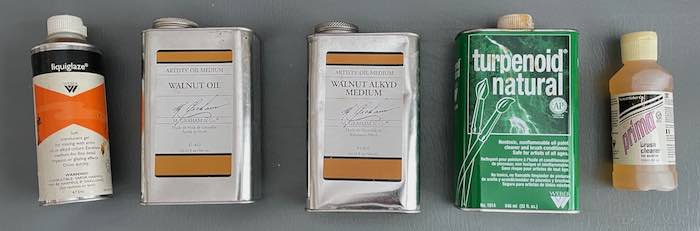
ALSO THINNER
THE LIQUIDS
That dissolve and mix with oils, resins, and other paint and varnish materials are employed by the painter principally as diluents or thinners. Their use as solvents in the literal sense of the word, that is, as means of putting resins and other solid materials into solution (as in the making of varnishes, etc.) is less frequent. They also find other applications in the arts, as varnish or paint removers, as cleansing materials in the restoration of paintings, and as agents in various art processes such as etching, lithography, etc.
The sole purpose of a thinner is to reduce the viscosity of a paint or varnish so that it may be easily applied to the surface in a thin film.
Volatile solvents and thinners for paints and varnishes were practically unknown to the ancients. Some of the crude petroleum from oil wells and some of the balsams and oleoresins from pine trees were distilled locally in a primitive manner by boiling the crude material in a vessel covered with a sheepskin laid over it fleece side down. The condensed volatile liquid which accumulated in the fleece was then squeezed out. Descriptions of distillation by use of an alembic, or still, begin with the physicians of Alexandria in the third century. The distillation of turpentine, alcohol, and other materials is mentioned in the writings of the early alchemists and crafts-men, but all the evidence indicates that these products were not applied or leaped to practical use (except-in medicine) prior to the fifteenth century,
when the commercial production and sale of volatile solvents and spirituous liquors began, and when recipes for varnishes containing them were first published. Many investigators attribute the introduction of oll painting, the is, the improvements of the fifteenth century, to the developments that made volatile thinners available to painters. Throughout the history of the materials of art we encounter such instances of a considerable lapse of time between the discovery or first application of a material and its adoption by or availability to painters in general.
PAINTERS' REQUIREMENTS FOR A THINNER
1. It must evaporate completely.
The rate or speed of its evaporation must be uniform and exactly suited to the manipulations of the painting process.
2.It must not exert a destructive solvent action on the underpainting.
3.It must not react chemically with the materials with which it is mixed
4.It must be perfectly miscible with the other ingredients in all proportions in which it is likely to be used.
5.The fumes should be non-injurious to health, and the odor should be nonresidual, that is, it should disappear entirely from the dried film within a reasonable length of time.
When such a material is used as a solvent (as distinguished from a thinner, the additional requirements are fairly obvious: its solvent action must be complete for the purpose, the solution should be stable and must not disintegrate under normal conditions.
EFFECT ON PAINT
The various volatile liquids which are suitable for use as paint and varnish thinners differ from one another only in such properties as rate of evaporation, solvent action, odor, etc. None of them has any binding or film-producing qualities, and none has any drying effect on paints and varnishes except as it allows the paint or varnish to be spread in a thinner film, a greater proportion of the oil or resin being thereby exposed to the drying action of the air.
THREE WARNINGS
1. A few volatile solvents are nonflammable, but as a group, most are highly flammable. Reduce the fire flamable, store quantities at one time and by keeping the containers tightly closed. Turpentine and mineral spirits are relatively safe in this respect; gasoline, benzoyl, and acetone are where people are smoking.
dangerous and should never be placed in the vicinity of open flame.
2. Continuous breathing of fairly concentrated solvent fumes in a poorly ventilated room can be injurious to health. In this respect, turpentine, mineral spirits, acetone, and alcohol are relatively safe when handled intelligently under good ventilation. The others, especially benzoyl, carbon tetrachloride, and proprietary paint removers, must never be breathed continuously. They are best used outdoors or in a well-ventilated studio with proper protection.
If there is any doubt about the contents or health hazards of a particular solvent (or any other material used in the studio, for that matter), the artist may obtain the appropriate information in America by requesting the Material Safety Data Sheet (MSDS) from the manufacturer for the questionable ma-serial. Anther source of information is the Art Hazards Information Center in New York City.
3. Most volatile solvents and solvent vapors can cause acute and/or chronic reactions as well as irritation if they come in contact with the skin or eyes.The proper selection of appropriate gloves and goggles for the particular solvent in use is therefore extremely important.
Solvent Allergy
Most persons can handle turpentine, mineral spirits, alcohol, and acetone in normal studio procedures without ill effects. However, some individuals are hypersensitive to some solvents, especially to turpentine, which can cause skin and respiratory irritations. Switching from turpentine to mineral spirits or wearing polyethylene gloves sometimes permits these people to continue using a solvent. It is, however, possible to continue to paint in oils without the use of these solvents. Oil paints may be thinned in the beginning stages of a painting by mechanical means. That is, the paint may be thinly applied with stiff brushes or rags. Subsequent layers may be thinned mechanically after the paint film has dried, as well as with small amounts of linseed oil. Brushes may be cleaned during painting with linseed oil, which will act as a weak solvent. Brushes may be cleaned after painting with soap and water.
Mutual solvents
Some liquids have the property of being miscible with two entirely separate classes of substances that are not miscible with each other; for example, acetone will mix with many oils and also with water. The addition of such solvents to certain mixtures of incompatible substances will produce a comas common solvents or coupling agents.
Frequently Asked Questions
What is the purpose of a thinner in painting?
The sole purpose of a thinner is to reduce the viscosity of paint or varnish so it can be applied easily in a thin, even film. Thinners do not bind, strengthen, or dry paint; they only make application more manageable.
What is the difference between a thinner and a solvent?
A thinner reduces the thickness of paint without dissolving solid materials. A solvent, in the strict sense, is capable of dissolving resins or other solids, such as when making varnishes. Most liquids used by painters function primarily as thinners rather than true solvents.
Did ancient painters use volatile thinners?
Volatile thinners were largely unknown in ancient times. While early distillation methods existed, volatile solvents were not widely available or used by painters until the fifteenth century, when commercial production made them accessible for artistic use.
Why must a good thinner evaporate completely?
Complete evaporation ensures that no residue remains in the paint film. Any non-evaporating material could weaken the paint structure, interfere with drying, or cause long-term deterioration.
Does a thinner help paint dry faster?
No thinner has drying or film-forming properties. Any apparent acceleration of drying occurs only because the paint is spread in a thinner layer, exposing more oil or resin to air.
Can a thinner damage an underpainting?
Yes. A poorly chosen thinner can dissolve or disrupt underlying paint layers. A proper thinner should not exert destructive solvent action on the underpainting.
What qualities do painters require in a thinner?
A suitable thinner must evaporate completely, evaporate at a controlled rate, be chemically inert, mix fully with paint materials, avoid damaging underlying layers, and produce fumes and odors that dissipate without harming health.
Are paint thinners flammable?
Most volatile thinners are highly flammable. Turpentine and mineral spirits are relatively safer, while gasoline, benzene-related products, and acetone are extremely dangerous near open flames or sparks.
Are solvent fumes harmful to health?
Prolonged exposure to concentrated solvent fumes in poorly ventilated spaces can be harmful. Good ventilation, limited exposure, and protective equipment are essential when using any volatile thinner.
What should artists do if they are sensitive or allergic to solvents?
Artists with solvent sensitivities may switch to milder options such as mineral spirits, wear protective gloves, or eliminate solvents entirely by thinning paint mechanically or with small amounts of oil.
Is it possible to paint in oils without using solvents?
Yes. Oil paint can be applied thinly using stiff brushes or rags, layered mechanically once dry, and brushes can be cleaned with linseed oil followed by soap and water.
What are mutual solvents?
Mutual solvents are liquids that can mix with two otherwise incompatible substances, such as oil and water. They act as coupling agents and allow certain mixtures to remain stable.